
 By concept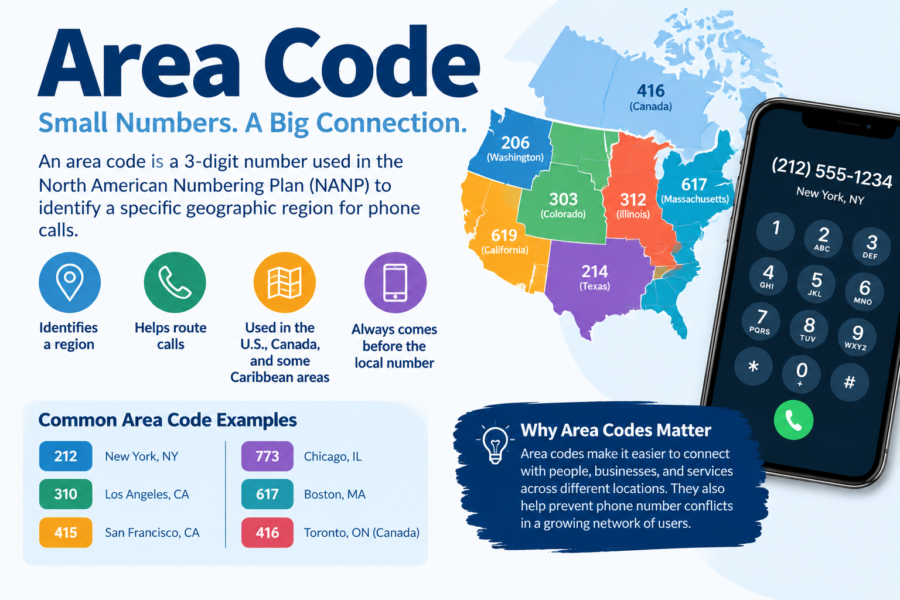
An area code is the three-digit prefix at the start of a ten-digit North American phone number that identifies the numbering region where the number was assigned.
In the North American Numbering Plan (NANP), it is also called an NPA (Numbering Plan Area) code. Geographic area codes map to territories; non-geographic codes (such as many toll-free numbers) map to a service class instead of a place.
Area codes help route calls, organize number supply, and give a rough sense of origin — but in the mobile and VoIP era, they no longer guarantee where a person is standing when they call.
Key Takeaways:
- An area code is the 3-digit NPA prefix in NANP numbers
- Geographic codes relate to territories; some codes are non-geographic
- Overlays add capacity without forcing existing numbers to change
- Ten-digit dialing is the normal companion of overlays
- Area code ≠ current physical location
- +1 is the country code for the NANP region
- Businesses should publish full numbers and plan for overlay transitions
- Area Code Directory Add-On (200–999)
Background: Why Area Codes Were Invented?
Before automated long-distance dialing, operators manually connected many calls. As telephone use exploded in the mid-20th century, North America needed a machine-friendly addressing system.
In 1947, the Bell System introduced a nationwide numbering plan that divided territories into Numbering Plan Areas (NPAs) and assigned each a unique three-digit code — the area code. Early assignments favored high-population regions with codes that were faster to dial on rotary phones (lower second digits and certain patterns). New York’s 212 and Los Angeles’s 213 are famous examples of early, high-demand codes.
The full NANP format became:
NPA-NXX-XXXX
- NPA = area code (3 digits)
- NXX = central office / exchange prefix (3 digits)
- XXXX = line number (4 digits)
For international dialing into the NANP region, the country code is +1.
What an Area Code Does — and Does Not Do
1. What it does
- Identifies the numbering plan area of assignment
- Helps networks route calls efficiently
- Expands available numbers when combined with prefixes
- Signals toll-free or specialty services for certain codes
2. What it does not reliably do
- Prove a caller’s current physical location
- Guarantee local billing treatment by itself in every scenario
- Remain unique to one city forever (overlays share geography)
A number with a Miami area code can ring on a phone in Seattle if the subscriber moved and kept the number through portability.
Geographic vs Non-Geographic Area Codes
Geographic codes
Tied to a territory such as a metro, region, or state portion. Examples people recognize include historic codes for major cities and newer overlay codes serving the same footprints.
Non-geographic codes
Not tied to a single local geography in the same way. The best-known group is toll-free service codes commonly associated with 800-family numbers (including later additions in the same service family). These are about how the call is billed and offered as a service, not about a neighborhood boundary.
There are also other special-purpose assignments within numbering administration for services that are not ordinary local lines.
Area Code Exhaust, Splits, and Overlays
Phone number demand grew with fax lines, modems, mobile phones, and always-on devices. When an area code approaches exhaustion (not enough prefixes left), regulators plan relief.
Split (older method)
Divide a region geographically. One side keeps the old code; the other gets a new code. Residents in the new-code zone must change numbers.
Pros historically: preserved seven-digit local dialing longer in some cases.
Cons: forces number changes, reprints, and confusion for businesses.
Overlay (dominant modern method)
Add a new area code on top of the same geographic area. Existing customers keep numbers; new lines may receive the new code. Local calls generally require 10-digit dialing.
Overlays became the standard relief method because they avoid forcing mass number changes. The tradeoff is that everyone must dial the area code even for “local” calls.
Ten-digit dialing
When multiple codes share a region — or when policy requires it — callers dial area code + seven-digit number for local calls. This also supported national three-digit services such as the 988 transition planning in the U.S., which required many areas to move to 10-digit local dialing so 988 could work consistently.
How Many Numbers Does an Area Code Hold?
In simplified NANP math taught across industry explainers:
- Each area code can support a large pool of central-office prefixes
- Each prefix supports up to 10,000 line numbers
- Practical usable capacity is lower than the theoretical maximum because of reserved patterns and assignment rules
That is why dense metros eventually need overlays even after efficiency measures such as number pooling.
Area Codes in Everyday Life
For consumers
- Recognizing hometown codes
- Spotting possible spam patterns (not definitive)
- Understanding why a neighbor has a different code after an overlay
- Keeping a number after a move (portability)
Businesses
- Local presence marketing (local caller ID)
- Multi-location call routing
- Toll-free branding for national support lines
- Compliance with dialing plan changes during overlays
For developers and telecom teams
- Number provisioning and CNAM considerations
- Validation of E.164 formats (+1 + 10 digits for NANP)
- Rate-center awareness for true local identity
Practical Tips: Working With Area Codes
- Store numbers in full international format when building contact systems: +1AAANNNXXXX.
- Assume 10-digit dialing in overlay regions.
- Do not treat area code as proof of location for fraud checks alone.
- Update websites and signatures when your business receives a new overlay code for new lines.
- Use official numbering resources (NANPA and carrier tools) for planning, not random blogs alone.
- For local marketing, match caller ID to the market you serve when possible.
- During overlay transitions, follow permissive dialing periods, then mandatory 10-digit dialing.
- Train staff and customers before the mandatory date to reduce failed calls.
- Separate vanity preference from capacity reality — popular codes may be scarce.
- For international users, remember +1 is the NANP country code, then the area code.
Common Mistakes and Challenges
- Mistake: Assuming a 212 number means the caller is in Manhattan right now
Solution: Treat area code as assignment history, not GPS. - Mistake: Publishing only seven-digit local numbers on national websites
Solution: Publish full numbers with area code. - Mistake: Ignoring overlay announcements until calls fail
Solution: Track local regulator/carrier notices. - Mistake: Using area code alone for credit or identity decisions
Solution: Combine with stronger verification signals. - Mistake: Confusing country code +1 with an “area code 1”
Solution: +1 is international country calling code for the NANP region. - Mistake: Thinking toll-free codes are geographic
Solution: They are service designations, not city codes.
Pros, Cons, and System Tradeoffs
Pros of the area-code system
- Scalable addressing across a huge region
- Supports automated routing
- Allows relief via overlays without changing every existing number
- Enables recognizable local and toll-free brands
Cons / friction
- Overlays end seven-digit local dialing habits
- Codes no longer map cleanly to “where someone is”
- Popular codes create prestige scarcity and secondary markets for numbers
- Consumers face periodic education campaigns for dialing changes
Balanced verdict
Area codes remain essential infrastructure. Their social meaning weakened with mobile portability, but their technical role in numbering and routing remains central.
Future Trends
- More overlays as number demand continues in growth markets
- Weaker geographic identity as VoIP and remote work normalize out-of-area numbers
- Stronger spam/scam analysis using many signals beyond area code
- Business demand for local presence numbers across multiple codes
- Continued administrative conservation tools (pooling, efficient assignment)
- Long-term planning for format expansion reserves within numbering policy
The phone number is becoming more like an identity token and less like a home address — yet area codes still structure the pool of available identities.
Related Numbering Concepts and Tools Compared
| Concept / resource | What it is | Best use | Limitation |
|---|---|---|---|
| Area code (NPA) | 3-digit region/service prefix | Identify assignment region | Not live location |
| Prefix (NXX) | 3-digit exchange code | Narrow number block | Still not precise address |
| Line number | Final 4 digits | Unique subscriber line in prefix | Meaningless alone |
| Country code +1 | NANP international code | Global dialing format | Not an area code |
| Overlay complex | Multiple NPAs, same geography | Number relief without renumbering | Requires 10-digit dialing |
| Split | Geographic division of an NPA | Historical relief method | Forces number changes |
| Toll-free codes | Non-geographic service family | National customer access | Not local presence |
| NANPA administration | Official NANP numbering admin | Authoritative planning info | Technical for casual users |
| Carrier number tools | Lookup/portability services | Practical provisioning | Varies by provider |
| E.164 formatting | Global number standard | Databases and apps | Users must store correctly |
Who Needs What Area-Code Knowledge
| Audience | What matters most | Action tip |
|---|---|---|
| Everyday consumers | Dialing rules + scam skepticism | Save full 10-digit numbers |
| Movers keeping numbers | Portability vs local identity | Keep number; update contacts |
| Small businesses | Local caller ID credibility | Match code to service market |
| Call centers | Routing + caller experience | Use local presence thoughtfully |
| App developers | Validation + formatting | Store +1 + 10 digits |
| Marketers | Regional trust signals | Avoid fake-local misleading tactics |
| Telecom analysts | Exhaust & relief planning | Follow NANPA projections |
| Journalists / researchers | Historical code identity | Distinguish assignment vs location |
| International callers | Country code vs area code | Dial +1 before NPA |
| Fraud teams | Weak location signal | Use multi-factor risk scoring |
Area Code Directory Add-On (200–999)
One-line status guide for North American Numbering Plan (NANP) style 3-digit codes
Important rules before the list
- Valid geographic NANP area codes use the form NXX where the first digit is 2–9 (not 0 or 1).
- Codes 200–199 are not used as standard geographic area codes.
- N11 codes (211, 311, 411, 511, 611, 711, 811, 911) are special service codes, not normal area codes.
- x9x codes (middle digit 9) are largely reserved for possible future numbering expansion.
- Status changes over time; for official assignment data use NANPA resources.
Below is a short one-line reference for each code from 200 to 999.
200–210
200 — Not in service; easily recognizable code (ERC) style, available for non-geographic use considerations.
201 — Northeast New Jersey (Bergen/Hudson area).
202 — Washington, D.C.
203 — Southwest Connecticut.
204 — Manitoba, Canada.
205 — Western/central Alabama (including Birmingham area).
206 — Seattle area, Washington.
207 — Maine.
208 — Idaho.
209 — Central California (Stockton–Modesto area).
210 — San Antonio area, Texas.
211-230
211 — Special N11 community information service (not a geographic area code).
212 — Manhattan, New York City.
213 — Los Angeles area, California (overlay complex).
214 — Dallas area, Texas.
215 — Philadelphia area, Pennsylvania.
216 — Cleveland area, Ohio.
217 — Central Illinois.
218 — Northern Minnesota.
219 — Northwest Indiana (Gary area).
220 — Central/southeast Ohio overlay area.
221 — Not in service / available for future geographic assignment.
222 — Not in service; ERC-style non-geographic candidate pattern.
223 — South-central Pennsylvania.
224 — North/northwest Chicago suburbs, Illinois.
225 — Baton Rouge area, Louisiana.
226 — Southwestern Ontario, Canada (overlay).
227 — Maryland (overlay with 240/301 region).
228 — Gulf Coast Mississippi.
229 — Southwest Georgia.
230 — Not in service / unassigned geographic candidate.
231-250
231 — Northwest Michigan.
232 — Not in service / unassigned.
233 — Not in service; ERC-style pattern.
234 — Northeast Ohio (Akron–Canton area overlay).
235 — Not in service / unassigned.
236 — British Columbia, Canada (overlay).
237 — Not in service / unassigned.
238 — Not in service / unassigned.
239 — Southwest Florida (Naples/Fort Myers area).
240 — Western Maryland / D.C. suburbs.
241 — Not in service / unassigned.
242 — Bahamas.
243 — Not in service / unassigned.
244 — Not in service; ERC-style pattern.
245 — Not in service / unassigned.
246 — Barbados.
247 — Not in service / unassigned.
248 — Oakland County area, Michigan.
249 — Northeast/central Ontario, Canada.
250 — British Columbia (non-Lower Mainland areas; overlay complex).
251-275
251 — Mobile area, Alabama.
252 — Eastern North Carolina.
253 — Tacoma area, Washington.
254 — Central Texas (Waco area).
255 — Not in service; ERC-style pattern.
256 — Northern Alabama.
257 — Not in service / unassigned.
258 — Not in service / unassigned.
259 — Not in service / unassigned.
260 — Northeast Indiana (Fort Wayne area).
261 — Not in service / unassigned.
262 — Southeast Wisconsin.
263 — Quebec, Canada (overlay-related assignments).
264 — Anguilla.
265 — Not in service / unassigned.
266 — Not in service; ERC-style pattern.
267 — Philadelphia area overlay, Pennsylvania.
268 — Antigua and Barbuda.
269 — Southwest Michigan.
270 — Western Kentucky.
271 — Not in service / unassigned.
272 — Northeast Pennsylvania.
273 — Not in service / unassigned.
274 — Not in service / unassigned.
275 — Not in service / unassigned.
276-299
276 — Southwest Virginia.
277 — Not in service; ERC-style pattern.
278 — Not in service / unassigned.
279 — Sacramento area, California.
280 — Not in service / unassigned.
281 — Houston area, Texas.
282 — Not in service / unassigned.
283 — Southwest Ohio overlay region.
284 — British Virgin Islands.
285 — Not in service / unassigned.
286 — Not in service / unassigned.
287 — Not in service / unassigned.
288 — Not in service; ERC-style pattern.
289 — Golden Horseshoe / GTA suburbs, Ontario.
290–299 — Mostly unassigned/reserved patterns; 299 ERC-style not in normal geographic service.
300–325
300 — Not in service; ERC-style non-geographic candidate.
301 — Western Maryland / D.C. suburbs.
302 — Delaware.
303 — Denver area, Colorado.
304 — West Virginia.
305 — Miami area, Florida.
306 — Saskatchewan, Canada.
307 — Wyoming.
308 — Western Nebraska.
309 — West-central Illinois.
310 — West Los Angeles / coastal LA area, California.
311 — Special N11 non-emergency municipal service code.
312 — Downtown Chicago, Illinois.
313 — Detroit area, Michigan.
314 — St. Louis area, Missouri.
315 — Syracuse area, New York.
316 — Wichita area, Kansas.
317 — Indianapolis area, Indiana.
318 — Northern/central Louisiana.
319 — Eastern Iowa.
320 — Central Minnesota.
321 — Central Florida (including Space Coast / overlay use).
322 — Not in service; ERC-style pattern.
323 — Los Angeles area, California.
324 — Jacksonville area overlay, Florida.
325 — West-central Texas (Abilene area).
326-350
326 — West-central Ohio overlay region.
327 — Not in service / unassigned.
328 — Not in service / unassigned.
329 — Not in service / unassigned.
330 — Akron–Canton area, Ohio.
331 — Chicago western suburbs, Illinois.
332 — New York City overlay (Manhattan-related complex).
333 — Not in service; ERC-style pattern.
334 — Southeast Alabama.
335 — Not in service / unassigned.
336 — Piedmont Triad, North Carolina.
337 — Southwest Louisiana.
338 — Not in service / unassigned.
339 — Eastern Massachusetts overlay.
340 — U.S. Virgin Islands.
341 — East Bay / Oakland area, California.
342 — Not in service / unassigned.
343 — Eastern Ontario, Canada.
344 — Not in service; ERC-style pattern.
345 — Cayman Islands.
346 — Houston area overlay, Texas.
347 — New York City overlay (primarily outer boroughs complex).
348 — Not in service / unassigned.
349 — Not in service / unassigned.
350 — Central California overlay (209 region).
351-379
351 — Eastern Massachusetts overlay.
352 — Central Florida (Gainesville area).
353 — Not in service / unassigned.
354 — Quebec, Canada overlay-related.
355 — Not in service; ERC-style pattern.
356 — Not in service / unassigned.
357 — Not in service / unassigned.
358 — Not in service / unassigned.
359 — Not in service / unassigned.
360 — Western Washington (non-Seattle core).
361 — South Texas (Corpus Christi area).
362 — Not in service / unassigned.
363 — Not in service / unassigned.
364 — Western Kentucky overlay.
365 — Golden Horseshoe / GTA suburbs, Ontario.
366 — Not in service; ERC-style pattern.
367 — Quebec, Canada.
368 — Alberta, Canada overlay-related.
369 — Not in service / unassigned.
370 — Not in service / unassigned.
371–379 — Generally unassigned/reserved; 377 ERC-style.
380-399
380 — Central Ohio overlay.
381–384 — Generally unassigned.
385 — Utah (Salt Lake area overlay).
386 — Northern Florida (Daytona area).
387 — Not in service / unassigned.
388 — Not in service; ERC-style pattern.
389 — Not in service / unassigned.
390–399 — Largely unassigned/reserved patterns.
400–425
400 — Not in service; ERC-style pattern.
401 — Rhode Island.
402 — Eastern Nebraska.
403 — Southern Alberta, Canada.
404 — Atlanta area, Georgia.
405 — Central Oklahoma (Oklahoma City area).
406 — Montana.
407 — Central Florida (Orlando area).
408 — San Jose area, California.
409 — Southeast Texas (Beaumont area).
410 — Baltimore area, Maryland.
411 — Special N11 directory assistance service code.
412 — Pittsburgh area, Pennsylvania.
413 — Western Massachusetts.
414 — Milwaukee area, Wisconsin.
415 — San Francisco area, California.
416 — Toronto, Ontario.
417 — Southwest Missouri.
418 — Eastern Quebec, Canada.
419 — Northwest Ohio (Toledo area).
420 — Not in service / unassigned.
421 — Not in service / unassigned.
422 — Not in service; ERC-style pattern.
423 — East Tennessee.
424 — Los Angeles area overlay, California.
425 — Seattle Eastside / suburban Washington.
426-450
426 — Not in service / unassigned.
427 — Not in service / unassigned.
428 — New Brunswick, Canada overlay-related.
429 — Not in service / unassigned.
430 — Northeast Texas overlay.
431 — Manitoba, Canada overlay.
432 — West Texas (Midland–Odessa area).
433 — Not in service; ERC-style pattern.
434 — South-central Virginia.
435 — Utah outside inner Salt Lake core.
436 — Not in service / unassigned.
437 — Toronto, Ontario overlay.
438 — Montreal area, Quebec.
439 — Not in service / unassigned.
440 — Cleveland suburbs / northeast Ohio.
441 — Bermuda.
442 — Southern California inland/coastal overlay regions.
443 — Maryland overlay (Baltimore region complex).
444 — Not in service; ERC-style pattern.
445 — Philadelphia area overlay, Pennsylvania.
446 — Not in service / unassigned.
447 — Illinois overlay regions.
448 — Florida panhandle overlay-related.
449 — Not in service / unassigned.
450 — Quebec (south of Montreal suburbs region).
451-499
451–457 — Mostly unassigned/reserved.
458 — Oregon overlay (Eugene region complex).
459 — Not in service / unassigned.
460 — Not in service / unassigned.
461 — Not in service / unassigned.
462 — Not in service / unassigned.
463 — Indianapolis area overlay, Indiana.
464 — Chicago south/west suburban Illinois overlay.
465 — Not in service / available for assignment in planning inventories.
466 — Not in service; ERC-style pattern.
467 — Not in service / unassigned.
468 — Quebec, Canada overlay-related.
469 — Dallas area overlay, Texas.
470 — Atlanta area overlay, Georgia.
471 — Not in service / unassigned.
472 — North Carolina overlay-related.
473 — Grenada.
474 — Saskatchewan, Canada overlay.
475 — Southwest Connecticut overlay.
476–477 — Generally unassigned; 477 ERC-style.
478 — Central Georgia.
479 — Northwest Arkansas.
480 — Arizona (Phoenix East Valley area).
481–483 — Generally unassigned.
484 — Eastern Pennsylvania overlay.
485–487 — Generally unassigned; 488 ERC-style not standard geographic.
489 — Not in service / unassigned.
490–499 — Largely unassigned/reserved patterns.
500–529
500 — Non-geographic / special service-style NPA family use (not ordinary city code).
501 — Central Arkansas.
502 — Louisville area, Kentucky.
503 — Northwest Oregon (Portland area).
504 — New Orleans area, Louisiana.
505 — New Mexico (including Albuquerque region).
506 — New Brunswick, Canada.
507 — Southern Minnesota.
508 — Central/southeast Massachusetts.
509 — Eastern Washington.
510 — Oakland/East Bay area, California.
511 — Special N11 traveler information service code.
512 — Austin area, Texas.
513 — Cincinnati area, Ohio.
514 — Montreal area, Quebec.
515 — Central Iowa (Des Moines area).
516 — Nassau County, Long Island, New York.
517 — South-central Michigan (Lansing area).
518 — Capital Region / northeast New York.
519 — Southwestern Ontario.
520 — Southern Arizona (Tucson area).
521–529 — Non-geographic 5XX resources (not standard city area codes).
530–541
530 — Northern California interior.
531 — Eastern Nebraska overlay.
532 — Non-geographic 5XX resource.
533 — Non-geographic 5XX resource.
534 — Northern Wisconsin overlay.
535 — Reserved/non-geographic style 5XX inventory.
536 — Not in service / unassigned.
537 — Not in service / unassigned.
538 — Non-geographic 5XX resource.
539 — Northeast Oklahoma overlay.
540 — Western/northern Virginia.
541 — Oregon outside Portland core.
542-574
542–558 — Mostly reserved/non-geographic 5XX inventory patterns.
544 — Non-geographic 5XX resource.
551 — Northeast New Jersey overlay.
557 — St. Louis area overlay, Missouri.
559 — Central California (Fresno area).
560 — Not in service / unassigned.
561 — Palm Beach area, Florida.
562 — Southeast Los Angeles County, California.
563 — Eastern Iowa.
564 — Western Washington overlay.
565 — Not in service / unassigned.
566 — Non-geographic 5XX resource.
567 — Northwest Ohio overlay.
568 — Not in service / unassigned.
569 — Reserved 5XX-style inventory.
570 — Northeast Pennsylvania.
571 — Northern Virginia overlay.
572 — Oklahoma overlay-related.
573 — East-central Missouri.
574 — North-central Indiana.
575–599
575 — New Mexico (non-Albuquerque regions).
576 — Not in service / unassigned.
577 — Non-geographic 5XX resource.
578 — Reserved 5XX-style inventory.
579 — Quebec overlay-related.
580 — Western/southern Oklahoma.
581 — Eastern Quebec overlay.
582 — Western Pennsylvania overlay-related.
583 — Not in service / unassigned.
584 — Manitoba, Canada overlay.
585 — Rochester area, New York.
586 — Macomb County area, Michigan.
587 — Alberta, Canada overlay.
588 — Non-geographic 5XX resource.
589 — Reserved 5XX-style inventory.
590–599 — Generally unassigned/reserved patterns; not standard local NPAs.
600–630
600 — Non-geographic / special Canadian non-geographic style uses (not a normal city code).
601 — Central Mississippi.
602 — Phoenix area, Arizona.
603 — New Hampshire.
604 — Metro Vancouver area, British Columbia.
605 — South Dakota.
606 — Eastern Kentucky.
607 — South-central New York.
608 — Southwest Wisconsin.
609 — Central/coastal New Jersey.
610 — Southeast Pennsylvania.
611 — Special N11 carrier repair service code.
612 — Minneapolis area, Minnesota.
613 — Eastern Ontario (Ottawa area).
614 — Columbus area, Ohio.
615 — Nashville area, Tennessee.
616 — West Michigan (Grand Rapids area).
617 — Boston area, Massachusetts.
618 — Southern Illinois.
619 — San Diego area, California.
620 — Southern Kansas.
621 — Houston area overlay, Texas.
622 — Non-geographic special-use style code family.
623 — Phoenix West Valley, Arizona.
624 — Not in service / unassigned.
625 — Not in service / unassigned.
626 — San Gabriel Valley, California.
627 — Not in service / unassigned.
628 — San Francisco area overlay, California.
629 — Nashville area overlay, Tennessee.
630 — Chicago western suburbs, Illinois.
631-660
631 — Suffolk County, Long Island, New York.
632 — Not in service / unassigned.
633 — Non-geographic special-use style.
634 — Not in service / unassigned.
635 — Not in service / unassigned.
636 — St. Louis western suburbs, Missouri.
637 — Not in service / unassigned.
638 — Not in service / unassigned.
639 — Saskatchewan, Canada overlay.
640 — New Jersey overlay-related.
641 — Central Iowa.
642 — Not in service / unassigned.
643 — Not in service / unassigned.
644 — Not in service; ERC-style pattern.
645 — Not in service / unassigned.
646 — New York City overlay.
647 — Toronto, Ontario overlay.
648 — Not in service / unassigned.
649 — Turks and Caicos Islands.
650 — San Mateo County / Peninsula, California.
651 — St. Paul area, Minnesota.
652–656 — Mostly unassigned/reserved.
657 — Orange County area, California.
658 — Jamaica overlay-related.
659 — Alabama overlay (205 region).
660 — North-central Missouri.
661-699
661 — Southern California (Bakersfield/Santa Clarita region).
662 — Northern Mississippi.
663 — Not in service / unassigned.
664 — Montserrat.
665 — Not in service / unassigned.
666 — Not in service; ERC-style pattern.
667 — Maryland overlay.
668 — Not in service / unassigned.
669 — San Jose area overlay, California.
670 — Northern Mariana Islands.
671 — Guam.
672 — British Columbia overlay.
673 — Not in service / unassigned.
674 — Not in service / unassigned.
675 — Not in service / unassigned.
676 — Not in service / unassigned.
677 — Not in service; ERC-style pattern.
678 — Atlanta area overlay, Georgia.
679 — Michigan overlay-related.
680 — New York overlay-related (315 region).
681 — West Virginia overlay.
682 — Dallas–Fort Worth area overlay, Texas.
683 — Ontario overlay-related.
684 — American Samoa.
685–688 — Generally unassigned; 688 ERC-style.
689 — Central Florida overlay.
690–699 — Largely unassigned/reserved patterns.
700–730
700 — Non-geographic special-use/interexchange style code.
701 — North Dakota.
702 — Las Vegas area, Nevada.
703 — Northern Virginia (D.C. suburbs).
704 — Charlotte area, North Carolina.
705 — Northeast/central Ontario.
706 — Northern/western Georgia.
707 — Northwest California.
708 — Chicago southern/western suburbs, Illinois.
709 — Newfoundland and Labrador, Canada.
710 — U.S. government special-use non-geographic code.
711 — Special N11 telecommunications relay service code.
712 — Western Iowa.
713 — Houston area, Texas.
714 — Orange County area, California.
715 — Northern Wisconsin.
716 — Buffalo area, New York.
717 — South-central Pennsylvania.
718 — New York City (Brooklyn/Queens/Staten Island complex).
719 — Southern Colorado (Colorado Springs area).
720 — Denver area overlay, Colorado.
721 — Sint Maarten.
722 — Not in service; ERC-style pattern.
723 — Not in service / unassigned.
724 — Western Pennsylvania.
725 — Las Vegas area overlay, Nevada.
726 — San Antonio area overlay, Texas.
727 — Tampa Bay area (western), Florida.
728 — Florida overlay-related.
729 — Not in service / unassigned.
730 — Illinois overlay-related.
731-751
731 — West Tennessee.
732 — Central/eastern New Jersey.
733 — Not in service; ERC-style pattern.
734 — Southeast Michigan (Ann Arbor/western Detroit suburbs).
735 — Not in service / unassigned.
736 — Not in service / unassigned.
737 — Austin area overlay, Texas.
738 — Los Angeles area overlay, California.
739 — Not in service / unassigned.
740 — Central/southeast Ohio.
741 — Not in service / unassigned.
742 — Ontario overlay-related.
743 — North Carolina overlay (336 region).
744 — Not in service; ERC-style pattern.
745 — Not in service / unassigned.
746 — Not in service / unassigned.
747 — Los Angeles area overlay, California.
748 — Not in service / unassigned.
749 — Not in service / unassigned.
750–751 — Generally unassigned.
752-760
752 — Not in service / unassigned.
753 — Not in service / unassigned.
754 — Broward County area, Florida.
755 — Not in service; ERC-style pattern.
756 — Not in service / unassigned.
757 — Hampton Roads, Virginia.
758 — Saint Lucia.
759 — Not in service / unassigned.
760 — Southern California desert/inland regions.
761-799
761 — Not in service / unassigned.
762 — Georgia overlay (706 region).
763 — Minneapolis northern suburbs, Minnesota.
764 — Not in service / unassigned.
765 — Central Indiana.
766 — Not in service; ERC-style pattern.
767 — Dominica.
768 — Not in service / unassigned.
769 — Mississippi overlay (601 region).
770 — Atlanta suburban area, Georgia.
771 — Washington, D.C. overlay.
772 — Treasure Coast, Florida.
773 — Chicago (non-downtown) area, Illinois.
774 — Massachusetts overlay (508 region).
775 — Northern Nevada (Reno area).
776 — Not in service / unassigned.
777 — Not in service; ERC-style pattern.
778 — British Columbia overlay.
779 — Illinois overlay (815 region).
780 — Northern Alberta, Canada.
781 — Boston suburban area, Massachusetts.
782 — Nova Scotia/PEI overlay-related.
783 — Not in service / unassigned.
784 — Saint Vincent and the Grenadines.
785 — Northern/western Kansas.
786 — Miami area overlay, Florida.
787 — Puerto Rico.
788 — Not in service; ERC-style pattern.
789 — Not in service / unassigned.
790–799 — Largely unassigned/reserved; 799 ERC-style.
800–830
800 — Toll-free non-geographic service code.
801 — Utah (Salt Lake core region).
802 — Vermont.
803 — Central South Carolina.
804 — Richmond area, Virginia.
805 — Central Coast / Ventura region, California.
806 — Texas Panhandle (Lubbock/Amarillo region).
807 — Northwestern Ontario.
808 — Hawaii.
809 — Dominican Republic (with related Dominican NPAs).
810 — East-central Michigan.
811 — Special N11 utility call-before-you-dig service code.
812 — Southern Indiana.
813 — Tampa area, Florida.
814 — Central/western Pennsylvania.
815 — Northern Illinois (outside Chicago core).
816 — Kansas City area, Missouri.
817 — Fort Worth area, Texas.
818 — San Fernando Valley, California.
819 — Western/northern Quebec.
820 — California overlay-related (805 region).
821 — South Carolina overlay-related.
822 — Toll-free family / reserved toll-free expansion style code.
823 — Not in service / unassigned.
824 — Not in service / unassigned.
825 — Alberta, Canada overlay.
826 — Virginia overlay-related.
827 — Not in service / unassigned.
828 — Western North Carolina.
829 — Dominican Republic.
830 — South-central Texas.
831-850
831 — Monterey Bay area, California.
832 — Houston area overlay, Texas.
833 — Toll-free non-geographic service code.
834 — Not in service / unassigned.
835 — Pennsylvania overlay-related.
836 — Not in service / unassigned.
837 — Not in service / unassigned.
838 — New York overlay-related.
839 — South Carolina overlay.
840 — California overlay-related (909 region).
841–842 — Generally unassigned.
843 — Coastal South Carolina.
844 — Toll-free non-geographic service code.
845 — Hudson Valley, New York.
846 — Not in service / unassigned.
847 — Chicago northern suburbs, Illinois.
848 — New Jersey overlay.
849 — Dominican Republic.
850 — Florida Panhandle.
851-860
851 — Not in service / unassigned.
852 — Not a NANP geographic area code for local U.S. service (do not confuse with international +852 Hong Kong country code).
853 — Not in service / unassigned.
854 — South Carolina overlay (843 region).
855 — Toll-free non-geographic service code.
856 — Southwest New Jersey.
857 — Boston area overlay, Massachusetts.
858 — San Diego area overlay, California.
859 — Northern/central Kentucky (Lexington area).
860 — Northern/eastern Connecticut.
861-899
861 — Not in service / unassigned.
862 — Northern New Jersey overlay.
863 — Central Florida (Lakeland area).
864 — Upstate South Carolina.
865 — East Tennessee (Knoxville area).
866 — Toll-free non-geographic service code.
867 — Northern Canada territories.
868 — Trinidad and Tobago.
869 — Saint Kitts and Nevis.
870 — Arkansas (outside central 501 core).
871 — Not in service / unassigned.
872 — Chicago area overlay, Illinois.
873 — Quebec overlay-related.
874 — Not in service / unassigned.
875–876 — 876 Jamaica; neighboring codes mostly special/unassigned.
877 — Toll-free non-geographic service code.
878 — Pittsburgh area overlay, Pennsylvania.
879 — Not in service / unassigned.
880–887 — Generally unassigned/reserved patterns.
888 — Toll-free non-geographic service code.
889 — Not in service / unassigned.
890–899 — Largely unassigned/reserved; not standard local NPAs.
900–925
900 — Premium-rate / special non-geographic service code family.
901 — Memphis area, Tennessee.
902 — Nova Scotia and Prince Edward Island, Canada.
903 — Northeast Texas.
904 — Jacksonville area, Florida.
905 — Golden Horseshoe / GTA suburbs, Ontario.
906 — Upper Peninsula, Michigan.
907 — Alaska.
908 — Central New Jersey.
909 — Inland Empire, California.
910 — Southeastern North Carolina.
911 — Emergency special N11 code (not an area code).
912 — Southeast Georgia.
913 — Kansas side of Kansas City metro / eastern Kansas.
914 — Westchester County, New York.
915 — El Paso area, Texas.
916 — Sacramento area, California.
917 — New York City overlay (originally wireless-heavy).
918 — Tulsa area, Oklahoma.
919 — Research Triangle area, North Carolina.
920 — Eastern Wisconsin.
921 — Not in service / unassigned.
922 — Not in service; ERC-style pattern.
923 — Not in service / unassigned.
924 — Minnesota overlay-related.
925 — East Bay inland suburbs, California.
926-950
926 — Not in service / unassigned.
927 — Not in service / unassigned.
928 — Arizona outside Phoenix core.
929 — New York City overlay.
930 — Southern Indiana overlay.
931 — Middle/southern Tennessee.
932 — Not in service / unassigned.
933 — Not in service; ERC-style pattern.
934 — Long Island overlay, New York.
935 — Not in service / unassigned.
936 — East Texas.
937 — Dayton area, Ohio.
938 — Northern Alabama overlay.
939 — Puerto Rico overlay.
940 — North Texas (outside core DFW in part).
941 — Southwest Florida (Sarasota area).
942 — Not in service / unassigned.
943 — Atlanta area overlay, Georgia.
944 — Not in service; ERC-style pattern.
945 — Dallas area overlay, Texas.
946 — Not in service / unassigned.
947 — Michigan overlay (248 region).
948 — Not in service / unassigned.
949 — Southern Orange County, California.
950 — Special-use code (not standard geographic NPA).
951-975
951 — Western Riverside County, California.
952 — Minneapolis southwestern suburbs, Minnesota.
953 — Not in service / unassigned.
954 — Broward County, Florida.
955 — Not in service; ERC-style pattern.
956 — Southern Texas border region.
957 — Not in service / unassigned.
958 — Special/testing-style non-standard use (not normal subscriber NPA).
959 — Connecticut overlay-related.
960–969 — Generally unassigned/reserved patterns.
970 — Northern/western Colorado.
971 — Oregon overlay (Portland region).
972 — Dallas area overlay, Texas.
973 — Northern New Jersey.
974 — Not in service / unassigned.
975 — Missouri overlay-related.
976-999
976 — Special service-style code (not normal geographic NPA).
977 — Not in service; ERC-style pattern.
978 — Northeast Massachusetts.
979 — Southeast Texas.
980 — Charlotte area overlay, North Carolina.
981 — Not in service / unassigned.
982 — Not in service / unassigned.
983 — Not in service / unassigned.
984 — North Carolina overlay (919 region).
985 — Southeast Louisiana.
986 — Idaho overlay.
987 — Not in service / unassigned.
988 — Reserved/protected for national 3-digit suicide & crisis lifeline use (not a standard geographic area code).
989 — Central/northern Michigan.
990–997 — Generally unassigned/reserved.
998 — Not in service / unassigned.
999 — Not in service; ERC-style pattern, not a standard geographic area code.
Quick reading notes
- If a line says unassigned/reserved, it is not a normal active local area code at the time of general public listings.
- If a line names a city/region, that is the common service area, often part of an overlay complex.
- Toll-free (800/833/844/855/866/877/888 and related) and 900 are service classes, not city codes.
- For legal/telecom provisioning decisions, verify against current NANPA data because implementations change.
Disclaimer: This directory is a practical short-form educational reference compiled from public NANP knowledge. It is not an official regulatory dump and may lag new overlays or reservations. Confirm critical assignments with official numbering administration sources before use in production systems.
FAQs
What is an area code?
The three-digit prefix identifying a numbering plan area (or certain non-geographic services) in a full NANP telephone number.
How many digits is an area code?
Three digits in the North American Numbering Plan.
Does an area code show someone’s location?
It shows where the number was assigned, not necessarily where the person is now.
What is an area code overlay?
A relief method that adds a new area code to the same geographic region so existing numbers can stay unchanged.
Why do I have to dial 10 digits for local calls?
Overlays and policy changes require the area code to distinguish numbers in shared regions and support consistent dialing plans.
What does +1 mean?
It is the international country calling code for the NANP (U.S., Canada, and certain Caribbean/territory participants), not an area code.
Are 800 numbers area codes?
They function as non-geographic service codes commonly grouped with toll-free calling, not ordinary city geography codes.
Who manages area codes in North America?
Numbering administration is handled through NANP administrative processes (commonly referenced via NANPA for assignment information).
Can two cities share patterns?
Multiple communities can share overlay complexes; conversely, large states contain many different codes.
Will area codes disappear?
Unlikely in the near term. The system continues to expand through overlays and conservation rather than eliminating prefixes.
Conclusion
Area codes began as a practical machine-routing solution for a continent-sized telephone network. They still organize number supply and call routing, even though mobile portability and internet calling diluted their meaning as “home markers.”
Understand them as assignment labels in a managed numbering system — essential, evolving, and easy to misread if you treat them as live GPS.
Quick Summary
An area code is the three-digit start of a North American ten-digit phone number identifying the numbering region of assignment. Modern overlays mean multiple codes can share one geography, ten-digit dialing is common, and an area code is no longer proof of a caller’s real-time location.
Short Content Disclaimer
This article is general information about telephone numbering concepts. Dialing rules, overlay dates, and assignments can change by region and over time. For official planning or assignment details, consult current NANPA/carrier resources and local regulatory notices.
Authority sources:
Historical and structural explanations in this guide draw on established NANP descriptions of area codes (NPAs), overlay relief methods, and publicly documented dialing-plan transitions such as ten-digit local dialing requirements.
Source: NANPA